
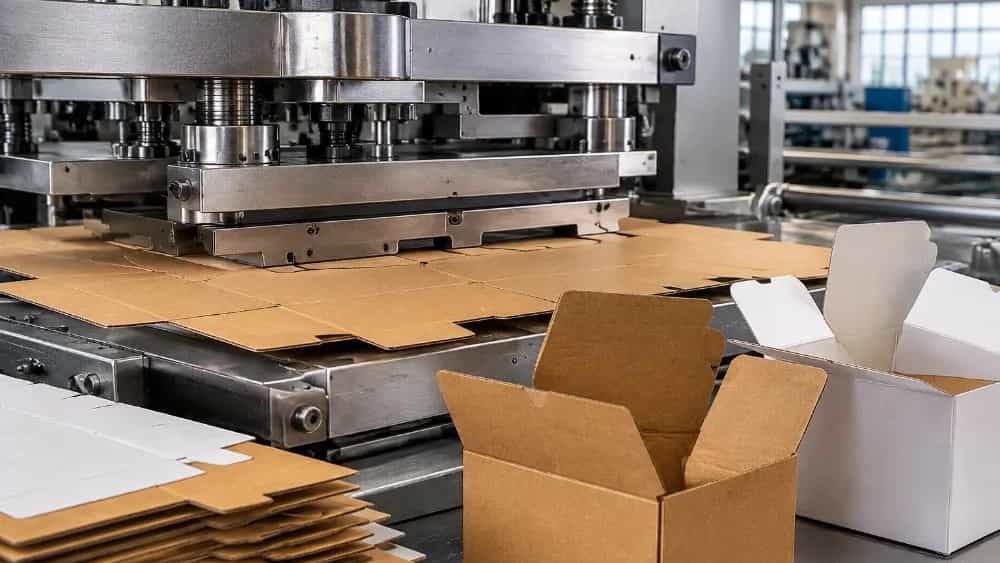
Manufacturing and ordering all kinds of boxes in Tehran includes dimensional engineering, selection of cardboard weight (Inderboard, Glossy, Kraft or Hardbox) and the execution of die-cut and precision cutting processes, which guarantees the physical health of the product and the visual credibility of the commercial identity. Workshops located in the capital, due to direct access to the raw materials market of Zahir-ul-Islam and well-equipped printing houses, realize the process of sampling exclusive sheets and various circulations with a high operating speed. To guarantee cost efficiency, the customer must specify the type of layered resistance, folding lines and locking angles of the floor in accordance with the mass of the product.
In practice, it has been observed that the major damage caused to the products sent to the stores is due to the error in calculating the compressive strength of the box against the vertical arrangement of storage. Persianbox box workshop in the assembly and molding lines by field investigation of the type of pressure applied to the packaging, adjusts the thickness factor of the layers based on the free fall test and floor friction instead of relying on theoretical assumptions.
Structural differences of cardboard and sheet types in Tehran box market
Choosing the right material is the main basis of mechanical resistance and graphic efficiency of packaging. Each package has a different chemical and physical structure that determines its performance in automatic devices or manual assembly.
Inner board and sanitary glass for sensitive items
Inderboard is the standard material of the pharmaceutical, cosmetic and health packaging industries due to its high density layered texture, double-sided whiteness and good tensile strength. 250 to 350 grams of inner board are bent without cracking in the automatic gluing machines, and their cutting edges do not leave fibrous shavings. Gloss with a uniform finish is chosen for separate color prints, but due to its more fragile texture, it always needs a cellophane protective layer.
Laminated congressional cartons, E-Float and B-Float
When the mass of the goods exceeds half a kilogram, three-layer cartons with single-face floating or e-float enter the production process. In the lamination process, a layer of offset printed cardboard is glued on the kraft cardboard congresses to increase the box's resistance to crushing in road physical pressures while maintaining the graphic beauty. In our workshop experiences, keeping the flute congresses aligned with the direction of the vertical force of the box minimizes the possibility of breaking the closed wall in the cargo.
Hardbox or hard brain boxes of MDF and mock-up cardboard
Hardboxes are produced with a 1.5 to 3 mm thick cardboard skeleton, and a coating of glossy, fancy or hardcover paper is drawn on them. These structures are used for heavy items, watches, gold, perfume and corporate gifts. The structural feature of the hard box is the non-deformation under lateral pressures and the precise sealing of the edges of the ninety-degree angle with the grooving device.